13→7
Close cycle cut nearly in half
Days to close, at a global shipping and logistics enterprise.

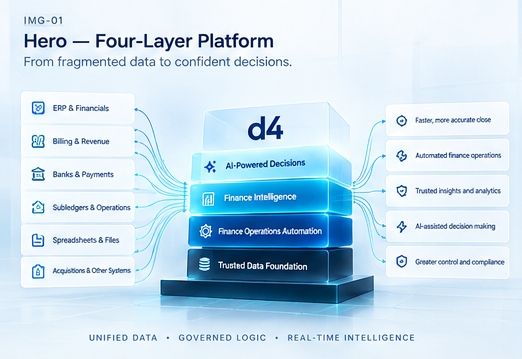
d4 is the Connected Finance platform for enterprises whose finance teams still reconstruct the truth manually. Trusted data foundation. Finance operations automation. Finance intelligence. AI-powered decisions. On one governed layer, working with the ERPs, EPMs, CRMs, and operational systems you already run.
Reconciliation, close, reporting, and forecasting operations governed on a single platform.
Days to close, at a global shipping and logistics enterprise.
Manual matching replaced by exception-based review.
Management packs generated on governed data.
Typical proof of concept on your priority use case.
At a global shipping and logistics enterprise with 10,000+ employees. POC timing is typical across deployments.
Every finance team we meet is running modern systems. ERP is live. CRM is connected. Billing is automated. And yet, every month, someone still reconstructs the truth by hand. The systems are connected. The numbers aren't. Here's where that breaks down.
Friction 01
Bank reconciliations, intercompany matches, vendor statement recs, GL tie-outs. Rule-based tools cap out somewhere around 70-90 percent auto-match. The manual tail lives in analyst spreadsheets, with logic that only the analyst remembers.
The Cost: Month-end deadlines missed. Audit trails thin. Institutional knowledge that walks out when the analyst does.
Friction 02
Multi-entity, multi-ERP close cycles blow past deadlines because blocking tasks surface too late. Delivery leads can't see readiness until the day of close. Escalations happen after the fact.
The Cost: Reporting deadlines missed. Board packages built under time pressure. Corrections booked to next period instead of caught in the current one.
Friction 03
Revenue in CRM. Revenue in billing. Revenue in the GL. Three numbers, none of them wrong on their own, none of them the same. Margin in operations. Margin in finance. Different definitions, different granularity, different periods.
The Cost: Leadership meetings start with reconciling the disagreement. Decisions delayed while finance defends the number.
Friction 04
Zero-charge orders. Broken billing integrations. Missed rebates. Contract terms that never made it into invoicing. The leakage is real, but it surfaces during the P&L review, weeks after the money has already exited.
The Cost: Recovery windows close. Corrective controls arrive late. Recurring leakage patterns stay hidden until someone looks backward.
Friction 05
Someone asks why margin moved. The answer takes two weeks. Analysts pull exports from three systems, build a bridge in Excel, and produce commentary that captures the "what" but rarely the "why." The rationale lives in one person's head.
The Cost: Finance answers the CFO's question after the decision window has closed.
Friction 06
The same two hundred management reports get rebuilt the same way every month, per entity, per BU, per period, mostly in Excel. Every KPI is a one-off build. Business users depend on analysts for every change.
The Cost: Analyst time consumed by report production. No shared KPI standard across the enterprise. Change requests queue behind IT.
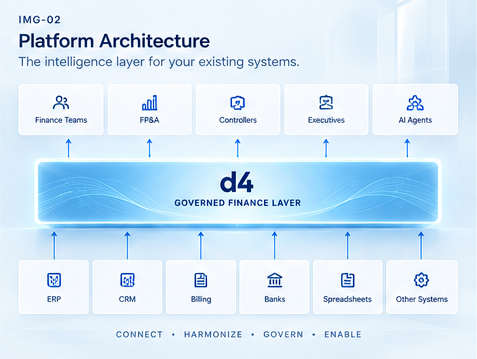
d4 sits above your ERPs, EPMs, CRMs, and operational systems. It connects to what you already run, reconciles financial truth at the transaction level, automates the reconciliation and close and reporting operations your team does manually today, and turns governed data into the metrics and insights the CFO actually uses.
d4 does not replace your ERP. It does not replace your consolidation tool. It does not replace your planning system. It sits above them, reconciles what they produce, and makes that truth usable across finance operations.
Connect and reconcile the financial truth. d4 maps every economic event once, validates source data on ingestion, and matches transactions as they arrive, with full lineage from source to report.
Common Finance Data Model. Data quality and validation. Reconciliation-native architecture. Audit-ready evidence on every item.
See capabilities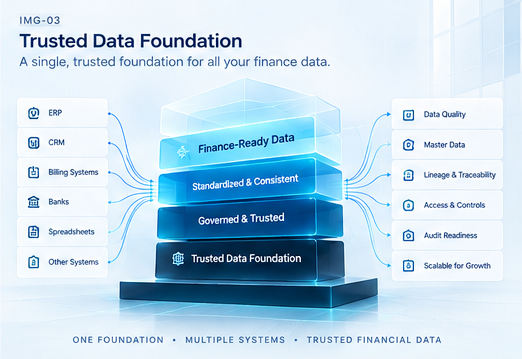
Automate the reconciliation, close, and reporting your team still does manually, with human-in-the-loop control where judgment matters.
Bank, intercompany, vendor, and GL matching. Invoice processing. AP and AR operations. Close orchestration. Report packs on governed data.
See capabilities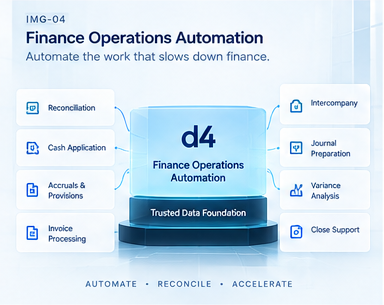
Turn governed data into the metrics finance actually reports on, with the drill-downs to explain them.
1,200+ KPI Metrics Store. Revenue intelligence. Business performance. Variance and driver-based analysis, on live reconciled data.
See capabilities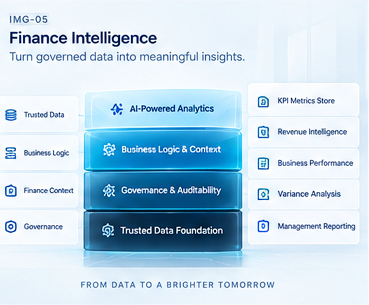
Ask questions in natural language. See what the CFO needs, when they need it.
Genie. CFO Cockpit. Insights Terminal. Anomaly detection and early-warning signals, grounded in reconciled data with lineage back to source.
See capabilities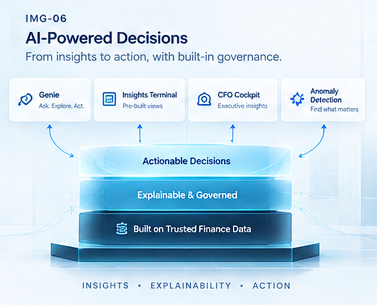
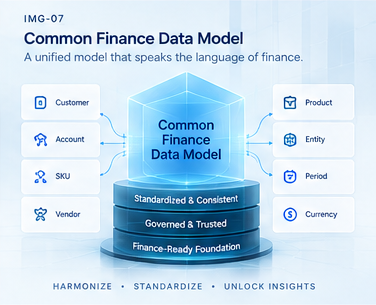
The Governed Base Layer. Where Financial Truth Gets Reconstructed.
Every downstream operation, reconciliation, close, reporting, forecasting, depends on data being reconciled and governed at the source. d4's foundation layer connects to your systems, harmonises the data, and produces the reconciled financial truth that everything else runs on.
Capability 01
Every economic event mapped once, resolved consistently across every system. d4 maps customer, account, SKU, vendor, product, entity, and period into a single canonical model.
Outcome: Every number in every report ties back to the same reconciled financial truth.
Capability 02
Bad data surfaced before it becomes a bad number. d4 validates source data on ingestion. Anomalies, gaps, and structural inconsistencies are flagged before they propagate into reports, reconciliations, and forecasts.
Outcome: Data problems caught at ingestion, not surfaced in a management review.
Capability 03
Reconciliation is how the platform works, not an add-on. Every transaction is matched, classified, and evidenced at the point of ingestion.
Outcome: Reconciliation is continuous, not a period-end scramble.
Capability 04
From every reported number, click back to the source transaction. d4 retains full lineage from source data through every transformation to the final metric.
Outcome: Every metric is defensible to the auditor, the controller, and the board.
Automate the Work Finance Still Does Manually.
Reconciliation, invoice processing, close orchestration, reporting. Finance operations that consume 60 to 80 percent of the team's time are automated on d4, with human-in-the-loop control where judgment matters.
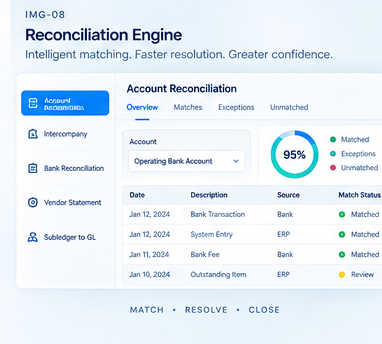
Capability 05
Bank, Intercompany, Vendor Statement, GL. Reconciled at the transaction level, not the net variance. AI-assisted matching layered on top of rule-based logic. Exceptions routed to human review with full context.
Outcome: Up to 90 percent automation of matching effort. Reconciliation becomes exception-based, not spreadsheet-based.
Capability 06
From invoice arrival to reconciled AP transaction, automated. OCR-based invoice capture across PDF, scanned, and EDI formats. Automated two-way and three-way PO matching with configurable tolerances.
Outcome: AP analysts skip routine invoices. Exceptions get the judgment. Spend visibility comes free.
Capability 07
Cash application, collections prioritisation, dispute tracking, all governed on live data.
Outcome: Less unapplied cash, prioritised collections, and revenue leakage caught while it can still be recovered.
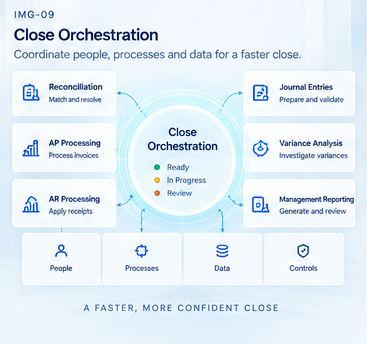
Capability 08
The close calendar, dependency map, and readiness dashboard, on live status. Blocking tasks surface days before the deadline, not the morning of.
Outcome: Close readiness visible seven days ahead of deadline. Escalations caught before close day.
Capability 09
Report packs generated on governed data, not rebuilt in Excel every month. Persona-based report templates. Configurable per client, per entity, per period.
Outcome: Consistent reporting SLAs across accounts. Self-service cuts analyst dependency. 8 weeks time to value on standard reporting packs.
Turn Governed Data Into the Metrics Finance Actually Reports On.
Once the data is reconciled and the operations are automated, the intelligence layer produces the metrics, drivers, and analysis that finance uses to run the business.
Capability 10
1,200+ finance KPIs across industries. 250+ KPIs per industry, ready out of the box. Every metric traces back to the reconciled source.
Outcome: Enterprise-wide KPI consistency. Finance, sales, and procurement speak the same metrics language.
Capability 11
Pipeline-to-revenue reconciled. Leakage detected before it becomes lost. Unified visibility across CRM, billing, orders, and collections.
Outcome: Revenue leakage surfaced before it hits P&L. Sales and finance work from one number.
Capability 12
Margin, working capital, and segment performance on governed data. Live view rather than month-end snapshot.
Outcome: Business performance visible in real time, not retrospectively.
Capability 13
The "why" behind the number, decomposed and documented. Materiality-based flagging separates real variances from noise.
Outcome: Variance commentary produced in hours, not weeks. Analyst time spent on judgment, not data gathering.
Ask a Question. See the Answer. Act on It.
The intelligence layer is only useful if finance leaders can actually consume it. d4's decision layer surfaces the right view for the right person, answers questions in natural language, and flags what needs attention before it becomes a problem.
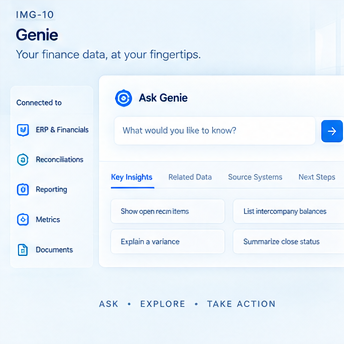
Capability 14
Ask a question. Skip building the dashboard. Genie is d4's natural-language interface to the platform. Answers are grounded in reconciled data, with lineage back to the source.
Outcome: Finance stops building dashboards for every ad hoc question. Answers arrive in minutes.
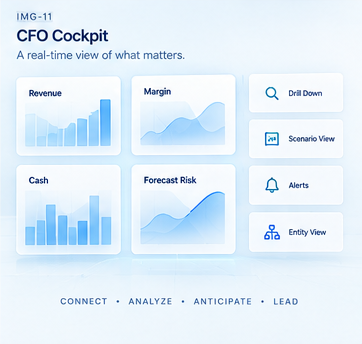
Capability 15
The CFO's live view. Margin, revenue, cash, forecast risk. Not another BI tool. A finance-first view built for the office of the CFO.
Outcome: The CFO sees the numbers that matter, when they matter, without waiting for the reporting cycle.
Capability 16
100+ reporting templates. Persona-based. Ready to run. Analysts start from a template that matches the question, not from a blank canvas.
Outcome: Standard reporting packs delivered without a build cycle. Analysts start with the right template instead of building from scratch.
Capability 17
Issues surfaced before they become close problems. d4 monitors reconciled data continuously and flags anomalies as they appear.
Outcome: Issues caught before close, not after.
At a global shipping and logistics enterprise with 10,000+ employees:
Close cycle cut nearly in half
reduction in reconciliation effort
automation of recurring management reporting
Typical time to first measurable outcome via POC
Multi-plant P&L, inventory, and procurement unified across ERPs.
Learn more →Revenue streams, subscriber data, and multi-entity consolidation reconciled in real time.
Learn more →Point-of-sale, inventory, and procurement connected across channels.
Learn more →Multi-entity close and multi-currency reconciliation automated.
Learn more →Compliance-ready financial data with full audit trail.
Learn more →Bring your priority use case. We'll run a proof of concept in 6 to 8 weeks on your actual systems and your actual data. No commitment until you see the outcome.